
Nitrogen is one of the most important elements for life on Earth. It plays a vital role in plant growth, food production, and ecosystem balance. Although nitrogen makes up about 78% of the Earth’s atmosphere, most living organisms cannot use it directly. This is why understanding How nitrogen moves through soil plants and atmosphere give us valuable insight into how nature sustains life.
This movement of nitrogen is part of a natural process called the nitrogen cycle, which connects the atmosphere, soil, plants, animals, and microorganisms. In this article, we will clearly explain how nitrogen moves through these systems, its biological importance, and why is the nitrogen cycle important for the environment and agriculture.
Introduction to Nitrogen Movement
When students ask How nitrogen moves through soil plants and atmosphere class, the answer lies in a continuous biogeochemical cycle. Nitrogen changes its chemical form as it moves from air to soil, into plants, through animals, and back to the atmosphere.
This movement is not random—it follows specific biological and chemical steps that ensure nitrogen remains available without accumulating excessively in one place.
[related_posts]
Nitrogen in the Atmosphere
Nitrogen exists in the atmosphere mainly as nitrogen gas (N₂). While abundant, this form is chemically stable and unusable by plants and animals.
So the big question is: how does nitrogen leave the atmosphere and enter the soil?
The answer begins with Nitrogen fixation.
Nitrogen Fixation: Entry Point of Nitrogen into Soil
Nitrogen fixation is the process by which atmospheric nitrogen is converted into ammonia (NH₃) or ammonium (NH₄⁺), forms that plants can eventually use.
This process happens in three main ways:
- By nitrogen-fixing bacteria in soil and plant root nodules
- Through lightning during thunderstorms
- Via industrial fertilizers
This explains How does nitrogen get into the soil—without fixation, nitrogen would remain locked in the atmosphere and unavailable to life.
Nitrogen in the Soil
Once nitrogen enters the soil, it becomes part of a complex underground system involving microorganisms.
Soil bacteria convert ammonia into nitrites and nitrates in a process called nitrification. These nitrates dissolve in soil water and become easily absorbable by plant roots.
At this stage, nitrogen is no longer just a gas—it becomes a nutrient that fuels plant growth.
Nitrogen Movement into Plants
Plants absorb nitrogen mainly in the form of nitrates (NO₃⁻) and ammonium (NH₄⁺) through their roots. Inside plants, nitrogen is used to produce:
- Proteins
- Chlorophyll
- Enzymes
- DNA and RNA
This step is often illustrated in a Nitrogen cycle diagram, where arrows show nitrogen moving from soil into plants.
Without nitrogen, plants would be unable to grow, photosynthesize, or reproduce.
[related_posts]
Transfer of Nitrogen Through the Food Chain
Animals obtain nitrogen by consuming plants or other animals. The nitrogen becomes part of animal tissues, supporting muscle growth, metabolism, and cellular functions.
When plants and animals die or release waste, decomposers break down organic matter and return nitrogen to the soil in a process called ammonification.
This recycling ensures nitrogen does not get wasted and continues circulating.
How Is Nitrogen Returned to the Atmosphere?
An important question in nitrogen cycling is How is nitrogen returned to the atmosphere.
This occurs through denitrification—a process carried out by specialized bacteria in low-oxygen environments. These bacteria convert nitrates back into nitrogen gas (N₂), releasing it into the atmosphere.
This step completes the cycle and prevents nitrogen from building up excessively in soil and water.
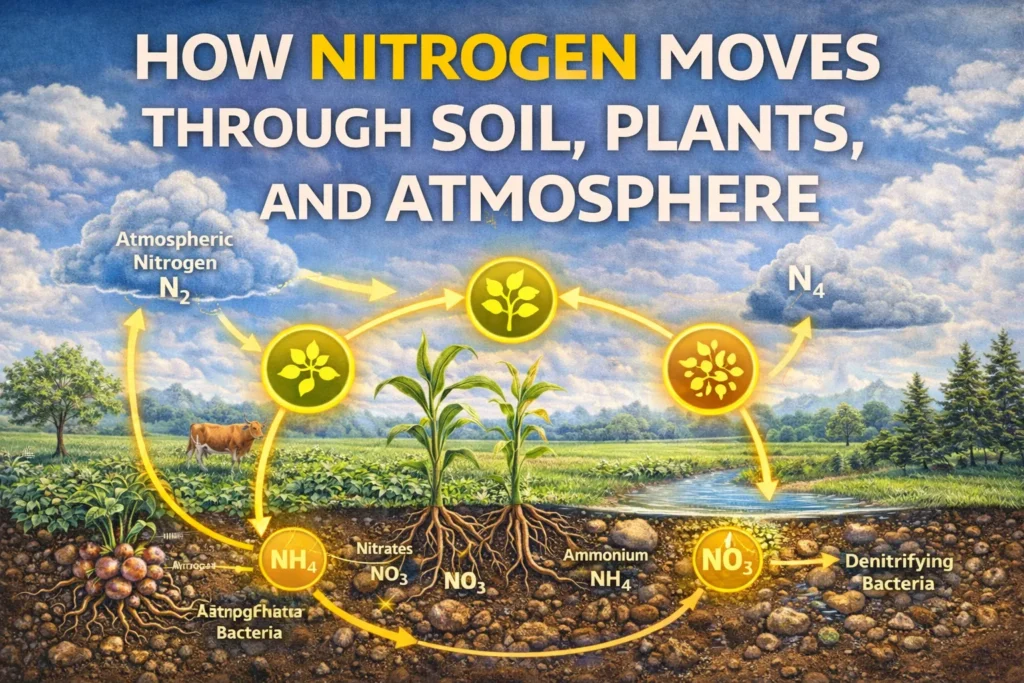
Nitrogen Cycle Diagram Explained Simply
A Nitrogen cycle diagram visually shows:
- Nitrogen gas in the atmosphere
- Nitrogen fixation into soil
- Plant uptake
- Animal consumption
- Decomposition
- Denitrification back to the atmosphere
Such diagrams are commonly used in classrooms because they make How nitrogen moves through soil plants and atmosphere class topics easier to understand.
Why Is the Nitrogen Cycle Important?
Many people ask Why is the nitrogen cycle important, and the answer is simple: life depends on it.
The nitrogen cycle is important because it:
- Makes nitrogen usable for plants and animals
- Maintains soil fertility
- Supports food production
- Prevents nitrogen pollution
- Keeps ecosystems balanced
Without nitrogen cycling, plants would stop growing, food chains would collapse, and ecosystems would fail.
Comparison with the Phosphorus Cycle
To better understand nutrient cycles, scientists often compare nitrogen cycling with the Phosphorus cycle.
While both cycles are essential:
- Nitrogen has a major atmospheric component
- Phosphorus mainly cycles through soil and water
- Nitrogen relies heavily on bacteria for transformation
This comparison highlights the unique importance of nitrogen movement between air, soil, and living organisms.
Human Impact on Nitrogen Movement
Human activities such as excessive fertilizer use and fossil fuel burning have altered how nitrogen moves through the environment.
Too much nitrogen can lead to:
- Water pollution
- Algal blooms
- Soil degradation
- Climate impacts
Understanding Why is the nitrogen cycle important helps promote sustainable farming and environmental protection.
Summary: How Nitrogen Moves Through Soil, Plants, and Atmosphere
To summarize:
- Nitrogen starts in the atmosphere as N₂
- Nitrogen fixation converts it into usable forms
- Soil bacteria transform nitrogen for plant uptake
- Plants absorb nitrogen and pass it through the food chain
- Decomposers recycle nitrogen back to soil
- Denitrification returns nitrogen to the atmosphere
This continuous movement explains How nitrogen moves through soil plants and atmosphere give a complete picture of nutrient sustainability on Earth.
Final Thoughts
Understanding nitrogen movement is essential for students, farmers, environmentalists, and anyone concerned about sustainability. The nitrogen cycle is a perfect example of how nature recycles resources efficiently.
By learning How nitrogen moves through soil plants and atmosphere, we can better appreciate the delicate balance that supports life—and why protecting this cycle is critical for the future.