
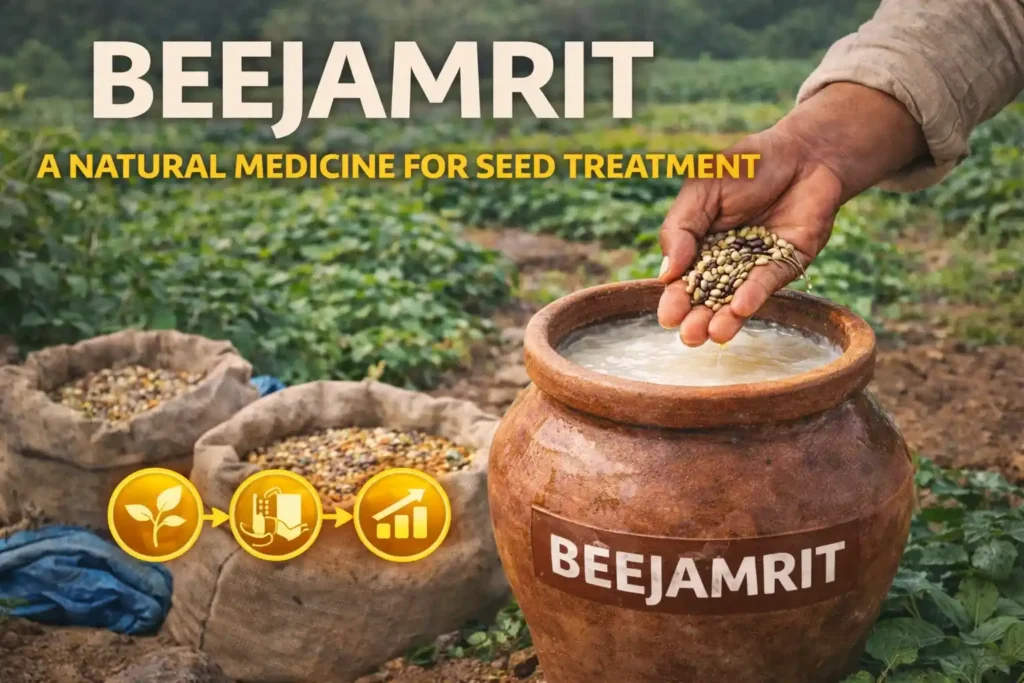

Organic and natural farming systems rely heavily on indigenous preparations that improve soil health, seed vigor, and crop resistance without harming the environment. Among these preparations, Beejamrit holds a special place as a powerful, low-cost, and eco-friendly seed treatment solution. Farmers practicing Zero Budget Natural Farming (ZBNF) and organic agriculture widely use Beejamrit to protect seeds from soil-borne and seed-borne diseases.
This article provides complete information about Beejamrit, its preparation, composition, uses, benefits, comparison with Jeevamrit, and its relevance in modern sustainable agriculture.
What Is Beejamrit?
Many farmers and students ask, What is Beejamrit?
Beejamrit is a traditional, natural seed treatment formulation prepared using indigenous cow-based inputs such as cow dung, cow urine, lime, soil, and water. It is primarily used to treat seeds before sowing to protect them from fungal, bacterial, and pest attacks.
In simple terms, Beejamrit acts as a natural medicine for seeds, improving germination and early seedling vigor while enhancing resistance against diseases.
[related_posts]
Importance of Beejamrit in Natural Farming
Seed treatment is the first and most crucial step in crop production. Poor seed health can result in low germination, weak plants, and reduced yields. Beejamrit helps address these problems naturally.
The Beejamrit Benefits include:
- Protection from seed-borne diseases
- Improved germination rate
- Enhanced root development
- Strong early plant growth
Because it is prepared using farm-available materials, it aligns perfectly with low-cost and sustainable farming practices.
Beejamrit Uses in Agriculture
The Beejamrit uses are mainly associated with seed and planting material treatment.
Some common Beejamrit uses include:
- Treatment of cereal seeds (rice, wheat, maize)
- Treatment of pulses and oilseeds
- Treatment of vegetable seeds
- Treatment of planting materials like tubers, cuttings, and seedlings
Farmers often search for Beejamrit uses pdf or Beejamrit uses ppt to understand application methods in detail, especially for training and extension programs.
[related_posts]
Beejamrit Preparation: Step-by-Step Method
Here’s the verified step-by-step Beejamrit preparation from the JustAgriculture PDF you shared:
Ingredients Needed
- Indigenous cow dung: 5 kg
- Cow urine: 5 Liters
- Cow’s milk: 1 Liter
- Lime (chuna or bud): 50 grams
- Water: 20 Liters
- Soil: 50 grams (preferably from around the roots of a banyan tree)
- Seeds: Up to 100 kg for treatment
Preparation Steps
- Take 20 Liters of water in a clean vessel.
- Tie 5 kg of cow dung in a cloth bundle and immerse it in water for 12 hours.
- In a separate pot, mix 50 grams of lime in 250 ml of water and leave overnight to slake.
- Lime helps balance pH, neutralizing the acidity of cow urine.
- After 12 hours, remove the cow dung bundle, squeeze it thoroughly so the nutrients mix with the water.
- Add 5 Liters of cow urine and 1 Liter of cow’s milk to the dung water.
- Mix in the slaked lime water slowly while stirring.
- Add 50 grams of soil (preferably from healthy farmland) and stir with a wooden stick.
- The resulting slurry is your Beejamrit solution, ready for seed treatment.
- Use it within 24 hours for best results.
Farmers often search for Beejamrit preparation TNAU PDF or Beejamrit preparation TNAU PPT to see graphical methods and validated recipes.
Method of Using Beejamrit for Seed Treatment
Once prepared, here’s how you use Beejamrit on seeds:
- Spread seeds to be sown on a clean surface or in a gunny bag.
- Dip the seeds in the Beejamrit solution for about 30 minutes.
- Remove and shade-dry the seeds until dry to touch.
- Sow the treated seeds immediately for maximum effectiveness.
Seeds treated this way are less likely to be attacked by soil-borne or seed-borne diseases after sowing.
[related_posts]
Beejamrit Uses in Agriculture
Beejamrit’s core application is seed treatment, but its uses extend beyond that. Farmers and gardeners use it for:
- Treatment of cereals like rice, wheat, and maize
- Seed treatment for pulses and oilseed crops
- Treatment of vegetable seeds
- Soil drenching in nurseries
- Dip treatment for planting materials (tubers, cuttings)
Extension materials such as Beejamrit uses PDF and Beejamrit uses PPT explain how to tailor application by crop type and seed size.
Preparation of Jeevamrit and Beejamrit
While Beejamrit is used for seed treatment, Jeevamrit is applied to soil. Many farmers prepare both together.
The Preparation of Jeevamrit and Beejamrit involves similar ingredients but different quantities and purposes.
Beejamrit → Seed and planting material treatment
Jeevamrit → Soil microbial enrichment
Understanding this distinction is critical for correct application.
Beejamrit and Jeevamrit: Key Differences
The relationship between Beejamrit and Jeevamrit is often misunderstood.
- Beejamrit is for seeds
- Jeevamrit is for soil
Farmers often download Beejamrit and jeevamrit pdf or Beejamrit and jeevamrit ppt for comparison during training sessions.
Some extension programs also provide Beejamrit and jeevamrit contact number for farmer support and guidance.
Jeevamrit Preparation Overview
Although this article focuses on Beejamrit, understanding Jeevamrit preparation is important for integrated natural farming.
The Jeevamrut preparation ppt and Jeevamrut preparation PDF explain how Jeevamrit supports soil microbial life and nutrient availability.
Together, Beejamrit and Jeevamrit create a complete natural crop management system.
Ghanjeevamrit and Its Preparation
Ghanjeevamrit is a solid form of Jeevamrit.
The Ghanjeevamrit preparation involves drying Jeevamrit ingredients into a powdered or granular form for easy storage and application.
Ghanjeevamrit is especially useful where liquid preparation and storage are difficult.
Panchagavya Preparation and Its Relation to Beejamrit
Another popular natural input is Panchagavya.
Panchagavya preparation uses five cow products and is mainly used as a foliar spray. While Panchagavya promotes plant growth, Beejamrit focuses on seed health.
Together, these inputs form a holistic natural farming approach.
Beejamrit Benefits for Farmers
The Beejamrit Benefits go beyond disease control.
Key benefits include:
- Low input cost
- Eco-friendly and non-toxic
- Improved crop establishment
- Reduced dependency on chemical fungicides
For small and marginal farmers, Beejamrit offers a practical solution for sustainable farming.
Practical Tips for Using Beejamrit
For best results:
- Use freshly prepared Beejamrit
- Treat seeds in shade
- Sow seeds immediately after drying
- Avoid chemical seed treatments alongside Beejamrit
Following these practices maximizes the effectiveness of Beejamrit.
Future Scope of Beejamrit
With growing interest in organic and natural farming, Beejamrit is gaining global recognition. Agricultural universities, NGOs, and government programs are promoting Beejamrit through training, publications, and digital resources.
This explains the increasing demand for Beejamrit preparation PDF, Beejamrit preparation TNAU review, and updated guidelines like Beejamrit preparation tnau 2026.
Conclusion: Why Beejamrit Matters
In conclusion, Beejamrit is a powerful natural medicine for seed treatment that combines traditional wisdom with modern sustainability goals. From Beejamrit composition to its wide-ranging benefits, this simple preparation offers a cost-effective and environmentally friendly alternative to chemical seed treatments.
When used alongside Jeevamrit preparation, Ghanjeevamrit, and Panchagavya preparation, Beejamrit becomes a cornerstone of natural farming.
Adopting Beejamrit is not just a farming practice—it is a step toward healthier soils, safer food, and a sustainable future.