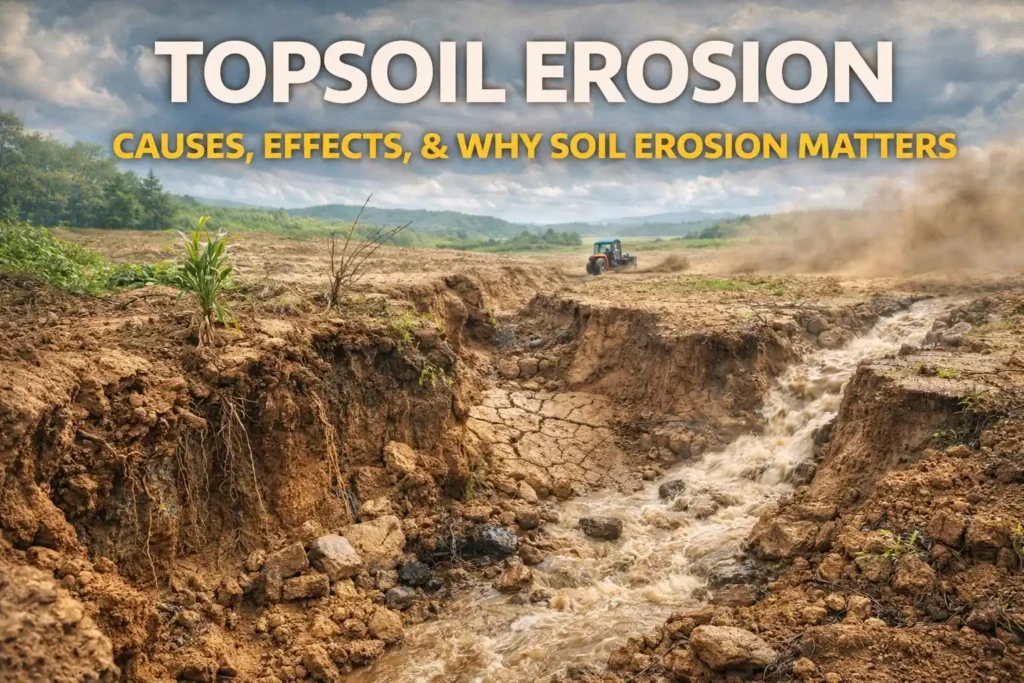

Soil is the foundation of life on land. It supports plant growth, stores water, supplies nutrients, and sustains ecosystems. However, soil is under increasing threat due to natural processes and human activities. One of the most damaging processes affecting land productivity today is topsoil erosion.
Across the world, fertile land is being degraded as soil particles are carried away by wind, water, and poor land management practices. Understanding soil erosion, its causes, and its long-term consequences is critical for protecting agriculture, food security, and the environment.
This article provides a complete, easy-to-understand explanation of soil erosion, focusing on what is topsoil erosion, erosion of soil, and the causes for soil erosion that are impacting our planet.
Understanding Soil and Soil Erosion
Before exploring erosion, it is important to understand soil itself. Soil is a natural resource formed over thousands of years through weathering of rocks and organic matter decomposition. The top layer of soil, known as topsoil, is the most fertile and biologically active part.
[related_posts]
The relationship between soil and soil erosion is direct—when soil loses its structure and protective cover, erosion begins. Erosion and soil are closely connected processes because erosion removes the very material that plants need to grow.
In simple terms, erosion soil refers to the wearing away and removal of soil particles from the land surface.
What Is Soil Erosion?
Many people ask, what soil erosion is or what is the soil erosion. Soil erosion is the process by which soil particles are detached and transported from one location to another by natural forces like wind and water.
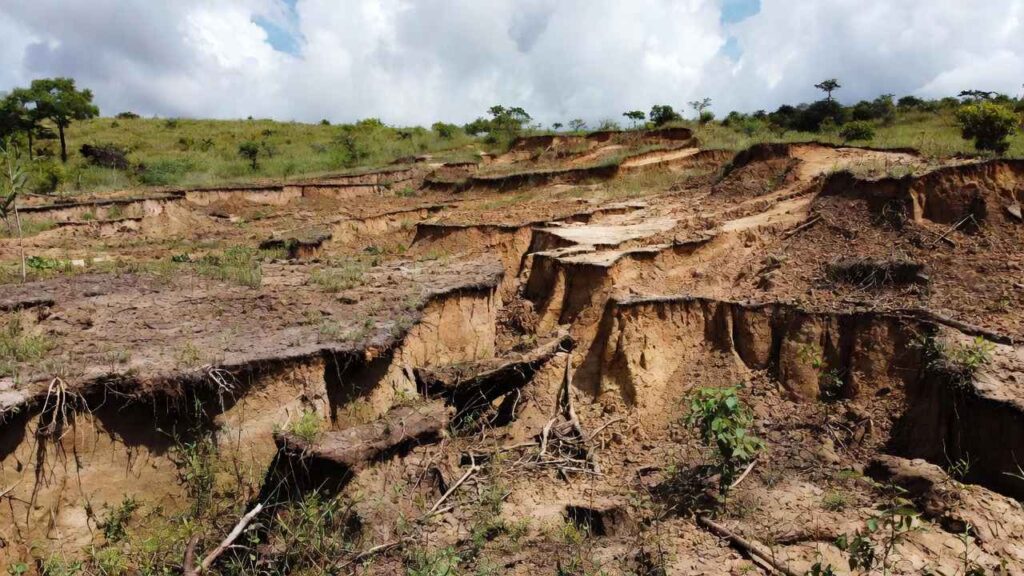
The soil erosion means loss of fertile land, reduced agricultural productivity, and environmental damage. When soil erosion occurs continuously, land becomes less capable of supporting crops and vegetation.
The soil erosion explanation involves both natural processes and human activities that accelerate the removal of soil beyond its natural rate of formation.
What Is Topsoil Erosion?
To understand land degradation fully, we must answer what is topsoil erosion.
Topsoil erosion refers specifically to the loss of the uppermost layer of soil, which contains most of the nutrients, organic matter, and microorganisms essential for plant growth. This layer is critical for agriculture and ecosystems.
When topsoil is eroded, what remains underneath is often infertile subsoil that cannot support crops effectively. This is why topsoil erosion is considered one of the most serious forms of land degradation.
What Is Erosion of Soil?
Another commonly asked question is what is erosion of soil. Erosion of soil occurs when soil particles are loosened and carried away by external forces such as rainfall, flowing water, or strong winds.
The erosion of soil can happen slowly over time or rapidly during extreme weather events. In both cases, the result is land degradation and loss of soil fertility.
[related_posts]
Types of Soil Erosion
Understanding different forms of soil erosion helps explain how and why land is degraded.
Water Erosion
Water erosion occurs when rainfall or irrigation water washes away soil particles. It is the most common type of erosion in agricultural areas.
Wind Erosion
Wind erosion occurs in dry and bare lands where strong winds carry away fine soil particles, leading to dust storms and loss of fertile soil.
Sheet Erosion
Sheet erosion is the uniform removal of a thin layer of soil from the land surface, often unnoticed until significant damage has occurred.
Rill and Gully Erosion
Rill erosion forms small channels, while gully erosion creates deep, wide channels that are difficult to repair.
Each of these contributes to erosion of soil and increases the risk of long-term land degradation.
Causes of Soil Erosion
The cause of soil erosion can be natural or human-induced. However, human activities have significantly accelerated erosion rates beyond natural levels.
Natural Causes
Rainfall, wind, slope, and soil type are natural factors that influence erosion. Steep slopes and intense rainfall increase erosion risk.
Human Causes
Human activities are the primary reasons for soil erosion today. These include deforestation, overgrazing, improper farming practices, and urban development.
Understanding the causes for soil erosion is essential for developing effective prevention strategies.
[related_posts]
Topsoil Erosion Causes
The topsoil erosion causes are often linked to poor land management. Removing vegetation exposes the soil surface, making it vulnerable to erosion.
Key topsoil erosion causes include:
- Deforestation
- Excessive ploughing
- Over-irrigation
- Construction activities
- Mining
Once topsoil is lost, soil regeneration can take hundreds of years.
Erosion and Soil in Agriculture
Agriculture is both affected by and contributes to erosion and soil degradation. Intensive farming practices disturb soil structure and reduce organic matter.
When fields are left bare after harvest, soil becomes exposed to wind and rain, accelerating soil erosion. Poor irrigation management can also wash away valuable soil nutrients.
This relationship between soil erosion and agriculture directly impacts food security and farmer livelihoods.
Effects of Soil Erosion
The effects of erosion go beyond the loss of soil.
- Loss of Soil Fertility
- Water Pollution
- Increased Flooding
- Desertification
These effects highlight why soil erosion is a global environmental concern.
[related_posts]
Soil Erosion Means Environmental Degradation
In environmental science, soil erosion means degradation of ecosystems. Plants lose their root support, microorganisms die, and biodiversity declines.
The link between soil erosion and climate change is also growing stronger, as degraded soils store less carbon and worsen global warming.
What Happens to Eroded Soil?
Once soil becomes eroded soil, it does not disappear—it is transported elsewhere. Often, it ends up in rivers, reservoirs, and oceans, causing sedimentation.
This sediment buildup reduces water storage capacity and affects hydroelectric power, irrigation systems, and drinking water quality.
Reasons for Soil Erosion in Developing Countries
Developing countries face higher risks due to population pressure and limited access to sustainable farming techniques. The reasons for soil erosion include:
- Overuse of land
- Lack of soil conservation awareness
- Poverty-driven deforestation
Addressing these causes requires education, policy support, and sustainable land management.
Soil Erosion Explanation for Students
For educational purposes, soil erosion explanation can be summarized as:
Soil erosion is the process by which fertile soil is removed from the land surface due to wind, water, or human activities, leading to reduced land productivity.
This explanation is commonly used in geography and environmental science classes.
[related_posts]
How Soil Erosion Affects Future Generations
If soil erosion continues unchecked, future generations will face reduced agricultural productivity and increased food insecurity. Once fertile land becomes degraded, restoring it is expensive and time-consuming.
Protecting soil today ensures sustainable food systems and environmental health tomorrow.
Preventing Topsoil Erosion
Preventing topsoil erosion requires a combination of traditional knowledge and modern techniques.
Soil Conservation Methods
- Cover cropping
- Contour farming
- Mulching
- Terracing
- Agroforestry
These practices protect soil from wind and water erosion.
Role of Vegetation in Controlling Erosion
Plants play a vital role in preventing erosion of soil. Roots hold soil particles together, while plant cover reduces the impact of rainfall and wind.
Reforestation and grassland restoration are effective ways to combat soil erosion.
Government and Community Role
Governments can reduce causes for soil erosion through land-use regulations, farmer education, and conservation programs. Community participation is equally important in protecting shared land resources.
Conclusion
In conclusion, topsoil erosion is one of the most serious environmental challenges facing the world today. Understanding what is topsoil erosion, what is erosion of soil, and the cause of soil erosion helps us recognize the urgency of protecting our land.
The connection between soil and soil erosion highlights the fragile balance that sustains life on Earth. Preventing erosion is not just an environmental responsibility—it is a necessity for food security, economic stability, and sustainable development.
By addressing the reasons for soil erosion and adopting conservation practices, we can protect fertile land for future generations.